Documentation strategy, information architecture, governance, developer documentation, and content transformation.
Documentation is often treated as a deliverable.
In practice, many documentation challenges stem from fragmented information, inconsistent standards, unclear ownership, and content that cannot scale alongside products and teams. I help organisations improve how information is created, managed, and delivered by focusing on the systems that support documentation as well as the content itself.
Overview
FreeBalance, a global provider of Public Financial Management (PFM) software, maintained a large documentation portfolio supporting customers, partners, consultants, trainers, and internal teams.
While the documentation contained valuable knowledge, information was distributed across 97 standalone PDF documents. As the organisation expanded, challenges around discoverability, governance, ownership, and scalability became increasingly difficult to manage. I led a documentation transformation initiative focused on understanding the existing content estate and defining a sustainable long-term solution.
The Challenge
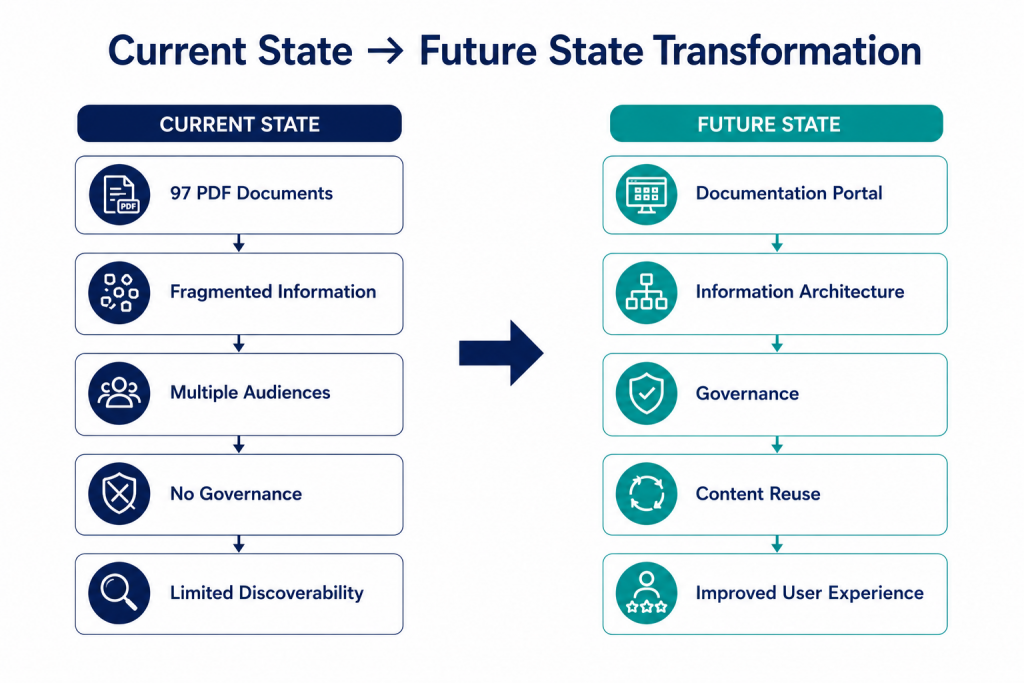
The challenges extended beyond content quality.
Information was fragmented across multiple documents, ownership was unclear, and users often needed to navigate several guides to complete a single task. Different audiences had different information needs, yet the existing documentation model largely treated them as a single group.
As the organisation grew, maintaining consistency and supporting partner enablement became increasingly difficult.
Key challenges included:
- Fragmented information
- Multiple audience groups
- Limited governance
- Content duplication
- Scalability concerns
- Poor discoverability
My Approach
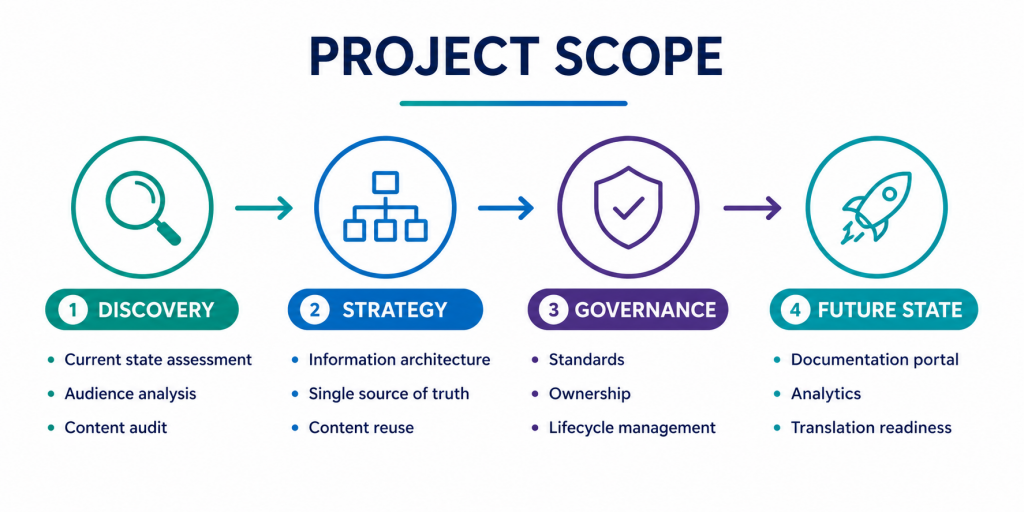
Rather than focusing solely on content migration, I adopted a strategy-led approach that combined content auditing, audience analysis, information architecture, governance planning, and documentation design.
The work included:
- Auditing 97 documents
- Analysing audience requirements
- Designing a future-state information architecture
- Defining governance and ownership models
- Introducing content reuse principles
- Creating an implementation roadmap
This approach ensured that technology decisions were supported by governance, content operations, and user needs.
Designing the Documentation Ecosystem
The proposed solution moved beyond a collection of documents towards a managed documentation ecosystem.
The design introduced:
- Information Architecture – A structure designed around user needs rather than document boundaries.
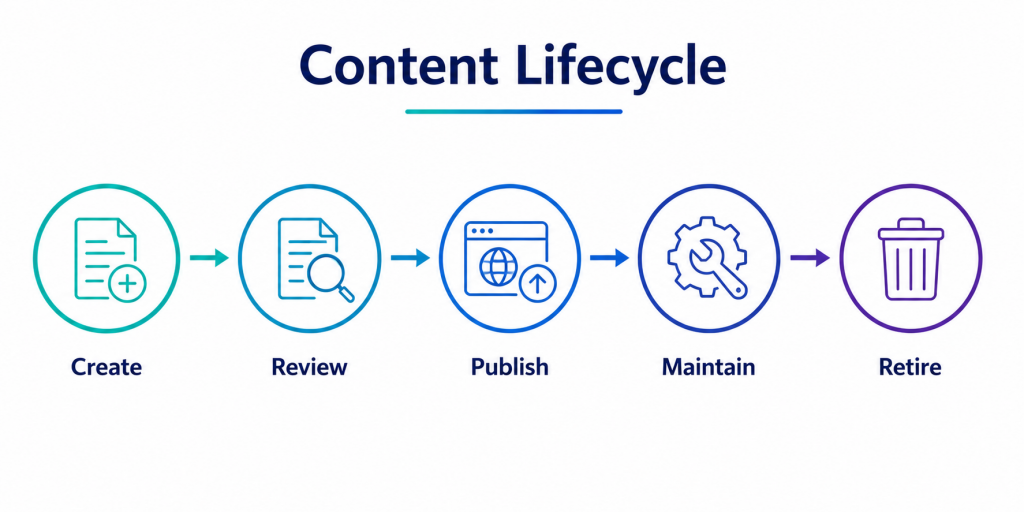
- Governance – Defined ownership, standards, review processes, and lifecycle management.
- Content Reuse – Topic-based authoring and single-source publishing to reduce duplication and simplify maintenance.
- Online Delivery – A searchable documentation portal supported by governance, analytics, and content operations.
- Future Growth – A scalable architecture capable of supporting additional audiences, multilingual content, partner resources, and future developer documentation.
Outcomes
The project established the foundations for a scalable documentation platform and repositioned documentation as a strategic business asset rather than a collection of independently maintained documents.
- 97 documents assessed
- 8 audience groups analysed
- 23 projects consolidated
- 2 years consultancy extension
- 1 stakeholder-approved roadmap
Reflection
One of the most important lessons from this project was that documentation challenges are rarely caused by a lack of content.
More often, they stem from fragmented information, unclear ownership, inconsistent standards, and approaches that struggle to scale alongside organisational growth. This project demonstrated that documentation transformation extends beyond content creation. Sustainable improvements often require organisations to consider governance, information architecture, content operations, and the systems that support content over time.
Download the Full Case Study
This summary provides and overview of the project. The full case study provides additional detail on the content audit, information architecture, governance framework, future-state documentation ecosystem, and implementation roadmap.