How a corporate rebrand became an opportunity to improve navigation, user experience, and content operations at scale
When Global Processing Services rebranded as Thredd, the documentation team faced a significant challenge.
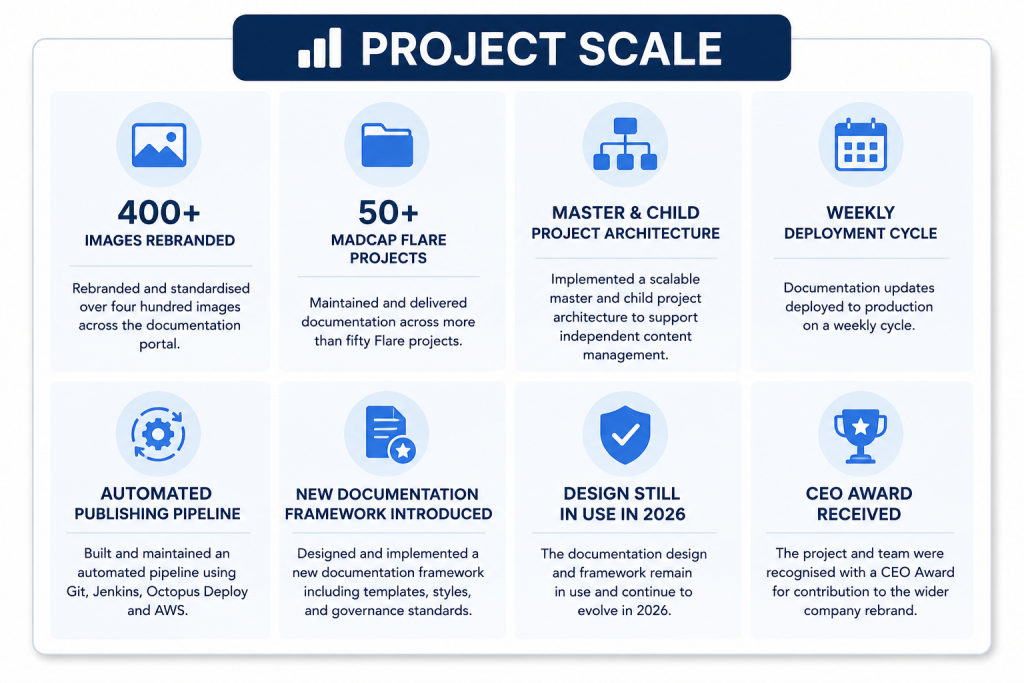
More than 50 documentation projects, hundreds of pages, and over 400 visual assets needed updating within a fixed delivery window. The documentation portal supported customers, partners, and internal teams through a complex ecosystem built on MadCap Flare, automated publishing pipelines, and a master-child project architecture.
The immediate requirement was to apply the new brand. The wider opportunity was to improve the documentation experience.
Rather than treating the initiative as a visual refresh, I used the rebrand as a catalyst to improve navigation, information architecture, content discoverability, documentation standards, and long-term maintainability across the documentation estate.
Project Snapshot
- Industry
Payments technology - Project type
Documentation transformation through rebranding - Documentation projects
50+ Madcap Flare projects - Visual assets
400+ diagrams and illustrations - Role
Technical Author and Portal Design Lead - Outcome
Rebrand delivered ahead of schedule
Team received CEO Award
Design is still in use in 2026
The Challenge
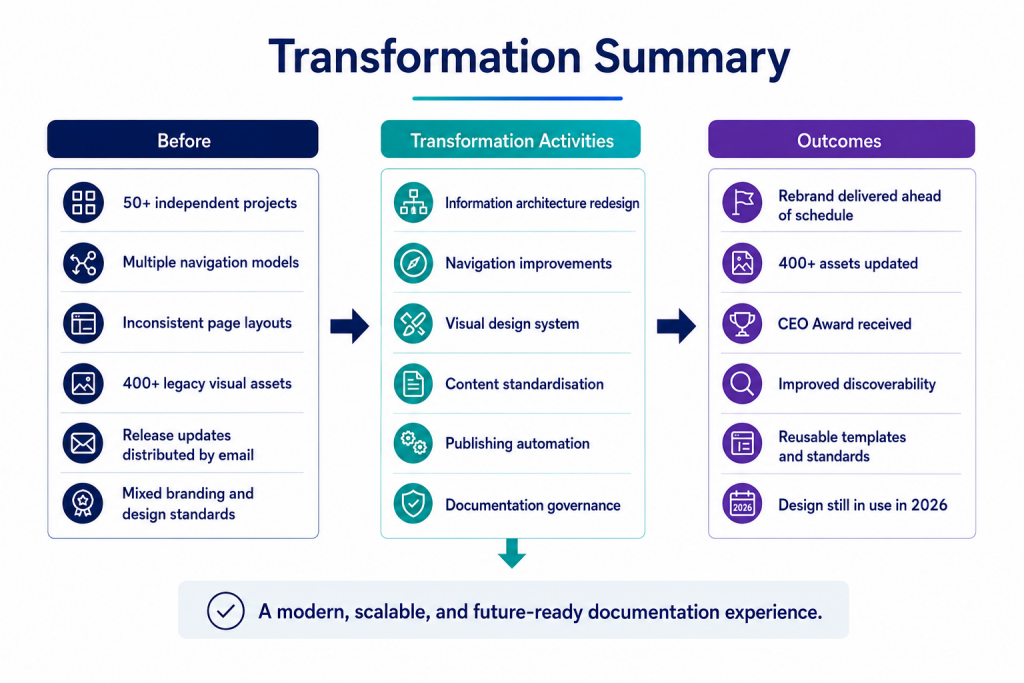
The documentation portal had evolved over several years. Different navigation approaches, page layouts, visual styles, and content structures had emerged across the platform. While the underlying publishing architecture remained effective, maintaining consistency had become increasingly difficult and the user experience varied between different areas of the documentation.
The rebrand added further complexity. Every aspect of the documentation estate needed to transition to the new Thredd identity while continuing to support existing users and established publishing processes. At the same time, the project had fixed deadlines and limited scope for architectural change.
The challenge was not simply to update branding. It was to improve the documentation experience without disrupting the systems that already supported it.
My Approach
As design lead for the portal redesign, I focused on improvements that would deliver meaningful value while remaining achievable within the project’s constraints.
First, I worked within the existing architecture rather than pursuing a high-risk redesign. This allowed the team to improve the user experience while maintaining publishing stability and meeting delivery deadlines.
Second, I redesigned navigation around user needs. Different approaches were introduced for high-level portal content and detailed technical documentation, creating a more intuitive browsing experience across the platform.
Finally, I used the rebrand to introduce shared standards, reusable templates, centrally managed resources, and consistent visual design principles. These changes supported the rebrand while creating a stronger foundation for future maintenance and growth.
Results
The project delivered significantly more than a successful corporate rebrand.
Key outcomes included:
- Rebrand delivered successfully and ahead of schedule
- More than 400 visual assets reviewed and rebranded
- Improved navigation and content discoverability
- Consistent design standards introduced across online and PDF documentation
- Reusable templates and shared resources established across the documentation estate
- Improved maintainability across more than 50 documentation projects
- Enhanced user experience for customers and internal teams
- Recognition through a company CEO Award
- Core design principles and frameworks still in use in 2026
The project demonstrated how a mandatory business initiative could be used to create broader improvements across documentation, user experience, and content operations.
What This Project Demonstrates
One of the most valuable lessons from this project was that transformation opportunities often arrive disguised as maintenance work. The original requirement was to apply a new corporate brand. The greater opportunity was to improve navigation, governance, content operations, and long-term sustainability.
Many documentation challenges appear to be content problems on the surface. In reality, they often reflect opportunities to improve the systems, standards, and processes that support content. This project demonstrates how documentation can contribute to wider organisational change when it is approached as a strategic capability rather than a collection of deliverables.
Download the full case study
This summary highlights the key challenges, decisions, and outcomes of the project. The full case study explores the documentation ecosystem in greater detail, including the strategic decisions, implementation approach, design framework, governance considerations, and lessons learned throughout the transformation.